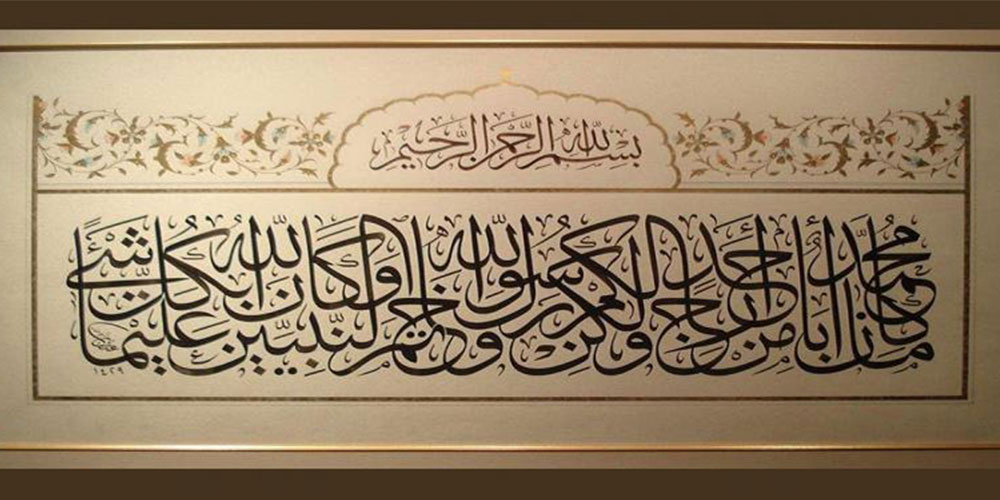
The Verse of Khātamīyya (Arabic: آيَة الخاتَميَّة) or Finality of Prophethood is Qur’an 33:40, and it is the only verse that explicitly introduces Prophet Muhammad (s) as the last prophet. The conclusion of prophethood with the prophethood of Muhammad (s) is an essential doctrine of Islam and a matter of consensus among Muslims.
At the beginning of the verse, the existence of a biological son for the Prophet (s) is denied, and subsequently, his finality is mentioned. Some Quranic exegetes believe that the connection between the opening and the end of the verse lies in the fact that, after severing the Prophet’s biological connection with others, God refers to his spiritual connection with all believers in the framework of prophethood and finality. The verse calls on its audience to obey the Prophet (s) due to his position as a messenger and leader.
Some, relying on the lexical difference between nabi and rasul, have argued that this verse only refers to the conclusion of prophethood (nubuwwa), not messenger ship (risala). Thus, it is possible for another messenger to come after Muhammad (s). In response to this ambiguity, Quranic exegetes have stated that the concept of “nabi” includes “rasul” as well—that is, every messenger is also a prophet. Therefore, with the conclusion of prophethood, messengership is also concluded.
Place and Significance
Qur’an 33:40 is referred to as the Verse of the Finality of Prophethood or the Verse of Khatam. This verse is considered the clearest evidence for the finality of Prophet Muhammad (s) and highlights one of his exclusive virtues, namely the conclusion of prophethood and messengership through him.
The finality of the prophethood of Prophet Muhammad (s) has been a matter of consensus among Muslims, and it is considered one of the essentials of Islam. This verse is regarded as the only one that includes both the name (Muhammad) and the title of the Prophet (Khatam al-Nabiyyin).
Text and Translation
| “ | مَا كَانَ مُحَمَّدٌ أَبَا أَحَدٍ مِنْ رِجَالِكُمْ وَلَٰكِنْ رَسُولَ اللَّهِ وَخَاتَمَ النَّبِيِّينَ ۗ وَكَانَ اللَّهُ بِكُلِّ شَيْءٍ عَلِيمًا | ” |
| — Qur’an 33:40 | ||
Occasion of Revelation
Regarding the occasion of the revelation of this verse, it is said that after Prophet Muhammad (s) married Zaynab bt. Jahsh, the divorced wife of Zayd b. Haritha (the Prophet’s adopted son), the hypocrites and some companions attempted to criticize this action. This was because, according to pre-Islamic traditions, an adopted son was considered no different from a biological son. Through the revelation of this verse, God opposed this pre-Islamic tradition and demonstrated that Zayd’s adoption was merely intended to elevate his status and that an adopted son could never take the place of a biological son, just as an adoptive father cannot take the position of a biological father. The verse further highlights another type of connection between the Prophet (s) and the people.
Connection between the Opening and End of the Verse
At the beginning of the verse, the fatherly relationship of the Prophet (s) with all men is denied, and it proceeds to mention his messengership from God and the conclusion of prophethood through Muhammad (s). To connect these themes, some have suggested that while God negates the biological connection of the Prophet (s) with others, He affirms the spiritual connection of the Prophet (s) with his community through his role as a messenger and the seal or finality of prophethood. In a similar interpretation, Prophet Muhammad (s) is regarded as the father of all believers, regardless of their faith, as he is the seal and inheritor of all prophets. In this sense, the Prophet’s love for his people, given that there will be no other prophet after him, is likened to the care of a father for his children, who have no one else but him.
Some believe that the mention of the Prophet’s messengership and his finality after the denial of his having a son serves to convey to the audience that obedience to the Prophet (s) is not due to a fatherly relationship but rather because of his role as a messenger and leader.
Lexical Meaning of “Khatam” and “Khatim”
Some of the Seven Reciters read the word with a kasra as “khatim,” while others, including ‘Asim and other reciters,read it with a fatha, as “khatam”. Khatam signifies that the Prophet Muhammad (s) is the last prophet, while khatim implies that he (s) is the one who concludes the line of prophethood. Some argue that the difference between the fatha and kasra does not significantly alter the meaning, as both convey the same notion.
Some Quranic exegetes believe that khatam means something by which an end is concluded, equivalent to sealing, which was used to protect a house, container, or letter from any subsequent alteration. On the other hand, since one of the tools used for sealing was rings engraved with the seal of an individual, khatam has also come to mean a ring. Additionally, decorative rings without an engraved seal were also referred to as khatam. Accordingly, some have assumed that the description of the Prophet of Islam (s) as the khatam of prophets does not imply the end of prophethood but rather aims to highlight his status as an adornment of the prophets. This interpretation has been rejected by some exegetes, given the peculiar connection between the term khatam and a ring.
Finality of Prophethood and Messengership
Main Article: Finality of Prophethood At times, doubts have been raised regarding the meaning of this verse and even the very notion of finality. Some have questioned whether God has only referred to the finality of prophethood through His Prophet, leaving open the possibility that the Prophet of Islam (s) might not be the last messenger. In response to this doubt, Quranic exegetes have stated that nabi encompasses rasul, and thus the finality of prophethood necessarily includes the finality of messengership. Similarly, messengership is among the matters of unseen knowledge communicated to people by some of the prophets—those who convey knowledge of the unseen (religion and religious truths) to humanity. As a result, the Prophet (s) is both the khatam of prophets and the khatam of messengers. His connection with the people is twofold: he is both a messenger sent by God and a prophet conveying unseen knowledge from God to the people, with all his actions carried out by God’s command. Other interpretations of the terms rasul and nabi have also been presented.
Is the Verse Incompatible with the Existence of the Prophet’s Sons and al-Hasanayn (a)?
Although the verse of finality explicitly states that the Prophet (s) is not the father of any of the men among his audience, the presence of the Prophet’s children, such as Qasim, ‘Abd Allah, and Ibrahim (all of whom passed away in childhood), as well as al-Hasan (a) and al-Husayn (a)—who were considered the Prophet’s children—has been seen as a challenge to this verse. In response, some have argued that the verse uses the term rijal (men), which does not include children who passed away in infancy. Additionally, al-Hasan (a) and al-Husayn (a) had not reached the age of maturity at the time of the verse’s revelation and were still children. In other words, God is stating in the verse that His Prophet is not the father of any of the men among you at the time.
Regarding al-Hasan (a) and al-Husayn (a), it has also been argued that they are indirect descendants, while the verse denies direct offspring. Others have suggested that the verse states the Messenger of God (s) is not the father of any of your men, while he can still be the father of men from his own.[41] This interpretation is supported by the verse of mubahala, where al-Hasan (a) and al-Husayn (a) are referred to as “abna’ina” (our sons).